
Views from
the Top

What you can see from 57m, 115m, and 276m above Paris — every landmark, every direction, every hour of the day.

360° of Paris
at Your Feet

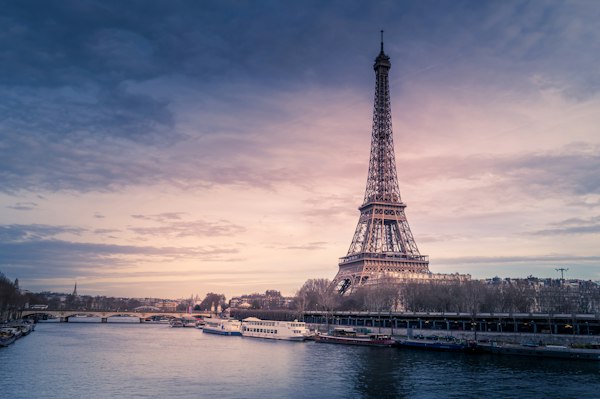
From the Eiffel Tower, you command an unbroken panorama in every direction. On clear days, the view stretches an astonishing 72 kilometers — far beyond the city limits, past the suburbs, and into the rolling countryside of the Île-de-France region.

72km Visibility

On the clearest days, the Eiffel Tower observation deck offers views stretching 72 kilometers in every direction. That is far enough to glimpse the spires of Chartres Cathedral on an exceptionally transparent winter morning. The combination of Paris's flat topography and the tower's height creates a viewing radius that few urban observation points in Europe can rival.

Unobstructed Horizon

Unlike observation decks enclosed in skyscrapers, the Eiffel Tower's open iron lattice means nothing blocks your sightline. There is no tinted glass distorting colors, no reflections competing with the view. The open-air platforms let you feel the wind and hear the city — an immersive experience that photographs cannot fully capture.

Three Distinct Perspectives

Each of the tower's three accessible levels offers a fundamentally different experience. The 1st floor feels intimate and connected to the streets below. The 2nd floor delivers the classic panoramic postcard view. The summit transforms Paris into an abstract map of rooftops, green spaces, and winding river.

Day and Night Transform

The same view changes completely between daylight and darkness. By day, you trace the geometry of Haussmann's boulevards and count the bridges over the Seine. By night, those same streets become rivers of light, and illuminated monuments glow like beacons across a vast carpet of amber and gold.

What You Can See
in Every Direction

The Eiffel Tower sits at the heart of western Paris. Here is what awaits your gaze in each cardinal direction.

N

Looking North

The white dome of Sacré-Cœur Basilica crowns the hilltop of Montmartre, the highest natural point in the city. Below it, the rooftops cascade downhill toward the grand thoroughfare of the Champs-Élysées. The imposing Arc de Triomphe stands at the western end of that avenue, its form unmistakable even from this distance. Beyond it, the modern skyscrapers of the La Défense business district punctuate the horizon — Paris's answer to Manhattan, bristling with glass towers and anchored by the Grande Arche.

E

Looking East

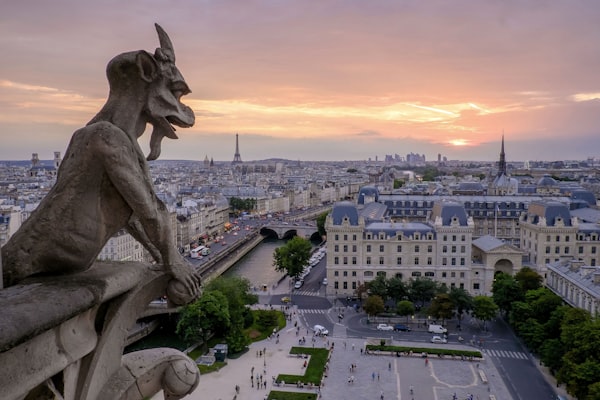
Eastward, the Seine curves gracefully toward the Louvre, its glass pyramid glinting when the sun hits it at the right angle. Beyond the Louvre, the reconstructed spire of Notre-Dame Cathedral rises from the Île de la Cité, beautifully restored after the 2019 fire. The Egyptian obelisk of the Place de la Concorde marks the transition between the Tuileries Garden and the Champs-Élysées. Further still, the classical dome of the Panthéon sits atop the hill of Sainte-Geneviève on the Left Bank.

S

Looking South

To the south, the dark silhouette of Montparnasse Tower dominates — the only modern skyscraper within central Paris and a useful reference point for orientation. Closer in, the golden dome of Les Invalides shines brilliantly, housing Napoleon's tomb beneath its gilded cupola. The tree-lined paths of the Luxembourg Gardens spread behind the Panthéon, a green rectangle visible from the upper levels. The Champ de Mars stretches directly below, its formal lawns leading toward the École Militaire.

W

Looking West

Westward, the Trocadéro gardens and the Palais de Chaillot frame the tower perfectly from below — though from up here, you look down upon them. The vast green expanse of the Bois de Boulogne spreads beyond, Paris's largest park covering over 800 hectares. On the horizon, the La Défense skyline appears again from this angle, its towers aligned along the historic Grand Axis that runs from the Louvre through the Arc de Triomphe and onward to the Grande Arche.
Views from
Each Floor

The Eiffel Tower is not one viewpoint — it is three. Each level reveals Paris in a fundamentally different way.

View from the Eiffel Tower first floor at 57 meters

1st Floor — 57 Meters

At 57 meters, you are close enough to the ground to see the details. People strolling the Champ de Mars look like miniatures but remain identifiable. The Seine's boat traffic is vivid, and nearby Haussmann-era apartment buildings reveal their ornate balconies and zinc rooftops. This level offers the most intimate connection between you and the city below. The glass floor here adds a thrilling vertical perspective — look straight down through 57 meters of open air to the ground below.

Height 57 meters
Best For Details, glass floor, photos of streets
Unique Feature Glass floor & outdoor terrace
Panoramic Paris view from Eiffel Tower second floor
The Sweet Spot

2nd Floor — 115 Meters

The second floor is widely considered the ideal viewing level. At 115 meters, you are high enough to see the full sweep of Paris — the river's curve, the radial boulevards, the patchwork of neighborhoods — yet low enough that individual buildings retain their character. Sacré-Cœur, Notre-Dame, the Louvre, and Montparnasse Tower are all clearly identifiable without a telescope. Free telescopes and interactive orientation screens help you name every landmark on the horizon.

Height 115 meters
Best For Panoramic photos, landmark spotting
Unique Feature Free telescopes & orientation screens
Pro tip: Spend extra time here. The 2nd floor combines the best of both worlds — panoramic scope with enough detail to make every photo meaningful.
Summit view from Eiffel Tower at 276 meters
Ultimate Vista

Summit — 276 Meters

The summit is where Paris transforms from a city into a living map. At 276 meters, the entire metropolitan area spreads below you in every direction. The Seine appears as a silver ribbon. Haussmann's radiating boulevards become visible as deliberate geometric patterns. On clear days, you can trace the horizon 72 kilometers out and spot features far beyond the city limits. This is the view that takes your breath away — the one that makes you understand why seven million people visit each year.

Height 276 meters
Best For The ultimate panorama, clear days
Unique Feature Gustave Eiffel's private office

How Weather
Affects Your View

Understanding Paris weather patterns is the difference between a 72km panorama and a 5km haze.

01

Clear Winter Days

The best visibility occurs on cold, dry winter mornings after a weather front has passed. Cold air holds less moisture, and post-rain atmospheres are scrubbed clean of particulates. December through February often delivers the longest sightlines, sometimes exceeding 80 kilometers. The trade-off is colder temperatures at the summit — dress warmly, as wind chill at 276 meters can be severe.

02

Summer Haze

Summer afternoons are the most challenging for views. Heat haze, humidity, and pollution combine to reduce visibility to 10–20 kilometers on typical July and August days. The city still looks beautiful in the warm light, but distant landmarks dissolve into a milky blur. For summer visits, arrive in the early morning when the air is coolest and clearest.

03

Rain and Fog

On rainy or foggy days, the summit may be closed entirely or shrouded in cloud. However, the 1st and 2nd floors often remain below the cloud line and provide atmospheric, moody views of rain-slicked Paris rooftops. Some visitors consider these conditions the most photogenic — the city takes on a cinematic, noir-like quality that sunny days cannot replicate.

04

What to Do on Hazy Days

If visibility is poor, focus on the lower levels. The 1st floor glass floor is just as thrilling in any weather. The 2nd floor restaurants and exhibits are enjoyable regardless of sightlines. Consider returning at night when city lights cut through haze far better than daylight, and the sparkling tower light show runs every hour on the hour after dark.

Telescopes, Screens
& the Glass Floor

Free Telescopes

The 2nd floor is equipped with free-to-use panoramic telescopes positioned around the entire perimeter. These high-powered viewers let you zoom in on specific landmarks — the gargoyles of Notre-Dame, the columns of the Panthéon, the gardens of the Palais Royal. No coins required. Simply step up and look.

Interactive Orientation Screens

Digital touchscreens on the 2nd floor overlay labels onto the real-time view, identifying buildings, monuments, and geographic features with distance measurements. These screens are available in multiple languages including English, French, Spanish, German, Chinese, and Japanese. They are especially helpful for first-time visitors unfamiliar with Paris geography.

The Glass Floor Experience

Installed on the 1st floor in 2014, the transparent glass floor covers roughly 100 square meters and lets you look straight down 57 meters to the ground. Walking across it provokes a genuine vertigo sensation even in visitors who consider themselves comfortable with heights. The iron lattice structure of the tower legs frames the view, and you can watch tiny figures moving on the esplanade far below. It is included with any ticket — no extra charge.

Gustave Eiffel's Private Office

At the very summit, a faithful recreation of Gustave Eiffel's private office is preserved behind glass. Life-size wax figures depict Eiffel receiving Thomas Edison, who visited in 1889 and presented Eiffel with a phonograph. The office contains period furniture, scientific instruments, and personal effects. It is a charming, unexpected detail at the highest point of the tower and one that many visitors walk right past without noticing.

Best Time of Day
for Views

The same observation deck delivers three completely different experiences depending on when you visit.

AM

Morning Clarity

Early morning (9:00–10:30) delivers the clearest air and the fewest crowds. The eastern-facing views are lit by warm front-light, making the Louvre, Notre-Dame, and the Panthéon glow. Morning mist occasionally fills the Seine valley, creating a dreamy effect as landmarks poke above the low fog. This is the best time for sharp, detailed photography and the longest visibility distances.

PM

Golden Hour Glow

Arriving 60–90 minutes before sunset gives you the famed golden hour light. The entire city turns warm amber and pink as the sun drops toward the western horizon. Shadows lengthen, architectural details become dramatic, and the Seine reflects the sky in shimmering gold. Time your visit so you are at the summit as the sun sets — then stay to watch the city lights flicker on across the panorama below.

EVE

City Lights at Night

After dark, Paris earns its nickname as the City of Light. From the tower, the illuminated Champs-Élysées forms a straight line of light to the Arc de Triomphe. Sacré-Cœur glows white on its hilltop. The Seine bridges are outlined in gold. And every hour on the hour, the Eiffel Tower itself sparkles with 20,000 twinkling lights for five minutes — though you will feel rather than see this show from the inside.

Identifying
Paris Landmarks

A practical reference for spotting and naming what you see from the Eiffel Tower observation decks.

The Golden Domes

Two golden domes are visible from the tower. Les Invalides (south) is the larger, shinier dome — Napoleon's tomb lies beneath it. The Panthéon (southeast) has a more subdued grey-green dome. Confusing the two is the most common mistake visitors make. Remember: gold and close is Invalides; grey and distant is the Panthéon.

The River Bridges

You can count over 30 bridges spanning the Seine from the tower. The most recognizable is Pont Alexandre III with its ornate gilded statues, directly east and slightly north. Pont Neuf (actually the oldest bridge) crosses the tip of the Île de la Cité. The modern Passerelle Débilly is the closest footbridge, practically at the tower's feet.

The Green Spaces

Paris reveals its surprising greenness from above. The Champ de Mars runs directly south from the tower's base. The Tuileries Garden stretches between the Louvre and Place de la Concorde. The Luxembourg Gardens are visible as a green rectangle on the Left Bank. And the enormous Bois de Boulogne fills the western horizon with forest.

Modern Paris

The La Défense skyscrapers form the most visible cluster of modern architecture, aligned perfectly along the Grand Axis to the northwest. Montparnasse Tower stands alone to the south, the only skyscraper in central Paris. The new Tribunal de Paris courthouse by Renzo Piano is visible to the north, its stepped glass form distinctive against the traditional skyline.

Eiffel Tower vs.
Other Paris Viewpoints

The Eiffel Tower is the most famous Paris viewpoint, but it is not the only one. Here is how they compare.

The Icon

Eiffel Tower

The highest accessible point with 360° panoramic views. Open-air platforms on the 2nd floor, enclosed summit. Free telescopes and interactive screens. The experience of ascending the tower is as memorable as the views themselves.

Height 276m (summit)
Key Advantage Highest point, iconic experience
Limitation Cannot see the Eiffel Tower itself

Montparnasse Tower

The 56th-floor observation deck at 210 meters offers the famous advantage: you can see the Eiffel Tower in your panorama. Locals often argue this is the best view in Paris precisely because it includes the tower. Shorter queues and open until 11:30 PM.

Height 210m (rooftop)
Key Advantage Eiffel Tower in the view
Limitation Southern location, lopsided panorama

Sacré-Cœur Steps

Free and beautiful. The steps of the basilica on Montmartre hill offer a south-facing view across all of Paris with the Eiffel Tower prominent in the skyline. The atmosphere is relaxed and bohemian. No ticket needed — just climb the hill.

Height 130m (hilltop elevation)
Key Advantage Free, atmospheric, includes tower
Limitation South-facing only, distant from center

Arc de Triomphe Rooftop

Standing atop the Arc de Triomphe places you at the center of the famous star-shaped intersection, with twelve avenues radiating outward. The Eiffel Tower and La Défense are both perfectly framed. Climb 284 steps to the roof terrace.

Height 50m
Key Advantage Champs-Élysées view, geometric star
Limitation Low elevation, stairs only

Everything Else
You Want to Know

What can you see from the top of the Eiffel Tower?

From the summit at 276m, you can see all of Paris and up to 72km on clear days. Key landmarks include Sacré-Cœur and Montmartre to the north, the Louvre and Notre-Dame to the east, Montparnasse Tower and Les Invalides to the south, and the Trocadéro and La Défense skyline to the west. On exceptionally clear days, you can even spot features nearly 80km away.

Which Eiffel Tower level has the best view?

The 2nd floor (115m) is widely considered the sweet spot. It is high enough for a full panorama yet low enough to identify individual buildings. The summit (276m) offers the most dramatic vista but landmarks appear smaller. The 1st floor (57m) provides an intimate perspective where you can see people on the Champ de Mars and experience the glass floor.

How far can you see from the Eiffel Tower?

On a clear day, visibility from the summit extends approximately 72km (45 miles) in every direction. Winter mornings with cold, dry air after a weather front provide the longest sightlines. Summer haze can reduce visibility to 10–20km. Morning visits generally offer better clarity than afternoon visits in any season.

Is the view better during the day or at night?

Both are spectacular in different ways. Daytime lets you identify landmarks and see distant horizons. Night transforms Paris into a carpet of lights. The best strategy is arriving 30–45 minutes before sunset to experience golden hour, then staying to watch the city lights emerge. The hourly sparkling light show is a bonus after dark.

Are there telescopes on the Eiffel Tower?

Yes, the 2nd floor has free-to-use telescopes and interactive orientation screens positioned around the observation deck. These panoramic viewers include directional markers showing the names and distances of visible monuments. No coins or tokens are required — they are included with your admission.

What is the glass floor on the Eiffel Tower?

The 1st floor features a transparent glass floor covering about 100 square meters, installed in 2014. You can look straight down 57 meters to the ground. It creates a genuine vertigo sensation and is included with any ticket at no extra charge. The glass panels are engineered to support significant weight and are perfectly safe.