
Sunrise & Sunset
at the Eiffel Tower

Golden hour, blue hour, twilight sparkle. The iron lady transforms with every shift of light—here is exactly when and where to witness it.

Why the Eiffel Tower
Changes Everything at Golden Hour

Eiffel Tower bathed in golden sunset light
Must Experience

A Monument Built for Light

The Eiffel Tower is not just iron and rivets. It is 18,038 pieces of wrought iron arranged in a lattice that catches, filters, and plays with light in ways that no solid structure ever could. At sunrise, warm amber rays thread through every gap in the ironwork, casting long shadows across the Champ de Mars. At sunset, the entire tower glows like molten bronze against a sky streaked with pink and violet. This is not hyperbole—it is physics. The lattice design means the tower is never fully opaque, never just a silhouette. It breathes light.

Why it matters: Most visitors see the Eiffel Tower under flat midday light. Those who arrive at golden hour see an entirely different monument—one that shifts from copper to gold to deep iron-grey within a single hour.
Paris skyline at golden hour with Eiffel Tower

Sunrise: The Quiet Tower

At dawn, the Eiffel Tower belongs to joggers, photographers, and those who set an alarm for something extraordinary. Crowds are virtually nonexistent. The light is soft and directional, painting long shadows across dewy grass. The city is waking up around you, and the tower stands in near-silence—a rare thing in one of the world's busiest tourist destinations.

Crowd Level Nearly Empty
Light Quality Soft, warm, directional
Best For Photography, solitude, romance
Eiffel Tower during sunset golden hour
Most Popular

Sunset: The Golden Transformation

Sunset is when the Eiffel Tower puts on its grandest show. The iron lattice catches the last warm rays and radiates gold. Then, as twilight deepens, the tower's 20,000 lights click on, transforming the structure from a sunlit monument into a glowing beacon. Time it right and you witness the complete metamorphosis—daylight to golden hour to blue hour to illumination.

Crowd Level Moderate to High
Light Quality Warm gold, then blue, then lit
Best For Full experience, couples, families

Watching the Tower
Wake Up.

Sunrise at the Eiffel Tower is one of the most peaceful experiences Paris offers. Here is everything you need to know to plan your dawn visit.

Winter

Dec–Feb Sunrise

Sunrise: 8:15–8:45 AM. The latest sunrises of the year mean you do not need to wake before dawn. Arrive by 7:45 AM. The low winter sun creates exceptionally long shadows and warm, horizontal light. Dress warmly—temperatures are often near freezing.

Spring

Mar–May Sunrise

Sunrise: 6:15–7:45 AM. Spring mornings bring soft mist over the Seine and cherry blossoms framing the tower. The light warms quickly. March still requires early alarms; by May, sunrise is early but the reward is blooming gardens at the tower's feet.

Summer

Jun–Aug Sunrise

Sunrise: 5:45–6:30 AM. The earliest sunrises demand commitment, but you are rewarded with the longest golden hours of the year. The Champ de Mars is peaceful at this hour, with only a few runners and fellow photographers. Light is golden and lingers.

Autumn

Sep–Nov Sunrise

Sunrise: 7:00–8:15 AM. Autumn mornings often bring atmospheric fog that wraps the tower's upper levels, creating dramatic layered compositions. The changing foliage along the Champ de Mars adds warm tones that complement the iron structure beautifully.

The Golden Hour
Month by Month

Golden hour begins roughly 60 minutes before sunset and continues for 20 minutes after. Here is your month-by-month timing guide for planning the perfect Eiffel Tower sunset experience.

January

Sunset: 5:10–5:30 PM

Golden Hour Starts: ~4:10 PM

Blue Hour Ends: ~5:55 PM

Strategy: Early sunsets mean you can combine sunset watching with dinner. The low angle of winter sun creates some of the most dramatic golden light of the year. First sparkle show at 6:00 PM.

February

Sunset: 5:30–6:20 PM

Golden Hour Starts: ~4:30 PM

Blue Hour Ends: ~6:45 PM

Strategy: Days are noticeably lengthening. Valentine's Day sunset at the tower is iconic but crowded at Trocadéro—try Pont de Bir-Hakeim instead for a more intimate experience.

March

Sunset: 6:25–7:15 PM (after DST change)

Golden Hour Starts: ~5:25 PM

Blue Hour Ends: ~7:40 PM

Strategy: Daylight saving adds an hour in late March. The equinox brings perfectly balanced light. Temperatures are mild enough for comfortable outdoor viewing without heavy winter gear.

April

Sunset: 7:15–8:45 PM

Golden Hour Starts: ~6:15 PM

Blue Hour Ends: ~9:10 PM

Strategy: Spring in full bloom. Cherry blossoms and spring flowers along the Champ de Mars add foreground interest for photographers. Mild evenings make this one of the most pleasant months for sunset viewing.

May

Sunset: 8:45–9:25 PM

Golden Hour Starts: ~7:45 PM

Blue Hour Ends: ~9:55 PM

Strategy: Long, warm evenings. Sunset is late enough to enjoy a full day of sightseeing before heading to your viewing spot. Picnics on the Champ de Mars during golden hour are a quintessential Paris experience.

June

Sunset: 9:25–9:50 PM

Golden Hour Starts: ~8:25 PM

Blue Hour Ends: ~10:30 PM

Strategy: The longest days of the year. Sunset after 9:30 PM means the light show sparkle does not start until 11:00 PM. Plan for a very late evening if you want to see both sunset and the sparkle. Bring a blanket and wine.

July

Sunset: 9:25–9:50 PM

Golden Hour Starts: ~8:25 PM

Blue Hour Ends: ~10:25 PM

Strategy: Similar to June. Bastille Day (July 14) features spectacular fireworks at the tower after sunset. Book your spot early—Trocadéro fills by 6:00 PM on this date. The extended twilight creates unforgettable photo conditions.

August

Sunset: 8:30–9:20 PM

Golden Hour Starts: ~7:30 PM

Blue Hour Ends: ~9:50 PM

Strategy: Sunsets begin retreating but remain late. Many Parisians are on holiday, so local crowds thin out even as tourists peak. Warm evenings are perfect for lingering. The 10:00 or 11:00 PM sparkle is reachable after sunset.

September

Sunset: 7:30–8:25 PM

Golden Hour Starts: ~6:30 PM

Blue Hour Ends: ~8:50 PM

Strategy: The sweet spot. Sunsets are at a sociable hour, temperatures are comfortable, and summer crowds begin thinning. The first sparkle show is reachable around 9:00 or 10:00 PM. Many photographers consider September the best month.

October

Sunset: 6:20–7:25 PM (before DST end)

Golden Hour Starts: ~5:20 PM

Blue Hour Ends: ~7:50 PM

Strategy: Autumn foliage creates stunning warm-toned foregrounds. After clocks change in late October, sunset drops to around 5:20 PM. The early darkness means you can see the tower lit up without staying out extremely late.

November

Sunset: 4:55–5:20 PM

Golden Hour Starts: ~3:55 PM

Blue Hour Ends: ~5:45 PM

Strategy: Short days mean golden hour happens mid-afternoon. This is actually convenient—you can enjoy sunset, blue hour, and the first sparkle show all before dinner. Moody skies add drama to photographs.

December

Sunset: 4:50–5:00 PM

Golden Hour Starts: ~3:50 PM

Blue Hour Ends: ~5:25 PM

Strategy: The earliest sunsets of the year. Holiday lights along the Champ de Mars complement the tower's golden glow. The complete sequence from golden hour through illumination takes barely 90 minutes, making it easy to fit into any schedule.
The 20–30 Minutes
Photographers Live For.

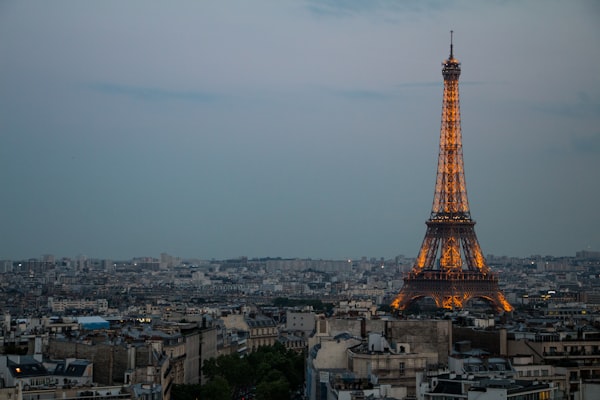
Blue hour is the brief window after sunset when the sky turns deep cobalt and the tower's lights create a perfect balance between artificial illumination and natural sky color. This is the single most photographed moment of the Eiffel Tower.

01

What Is Blue Hour?

Blue hour occurs 15–40 minutes after the sun dips below the horizon. The sky transitions from warm twilight to a rich, saturated cobalt blue. During this window, the Eiffel Tower's 20,000 golden bulbs are already lit, but the sky is not yet black. The result: the tower glows warmly against a deep blue canvas—the iconic postcard image.

02

Why Photographers Love It

Blue hour provides balanced dynamic range. The sky is bright enough to register color and detail, while the tower's lights are bright enough to glow without overexposing. You get detail in both highlights and shadows. During full darkness, the sky goes black and loses all atmosphere. Blue hour is the sweet spot.

03

Camera Settings

Use a tripod. Shoot in manual mode: ISO 100–400, aperture f/8–f/11 for sharpness across the frame, and shutter speeds of 2–15 seconds depending on ambient light. A remote shutter release prevents camera shake. Shoot in RAW for maximum editing flexibility with the blue and gold tones.

04

Timing Your Arrival

Arrive at your chosen spot at least 45 minutes before sunset to set up and claim your position. Shoot through the entire transition: golden hour, sunset, twilight, blue hour. The best blue hour images happen in a window of roughly 10 minutes. Do not pack up early—the last moments are often the most dramatic.

Where to Watch
Sunrise & Sunset

The same locations work for both sunrise and sunset, but the direction of light changes everything. Here is how each spot performs at different times of day.

Trocadéro view of the Eiffel Tower at golden hour
Top Spot

Trocadéro Esplanade

The most iconic viewpoint in Paris. The elevated terrace faces east-southeast toward the tower, with the Jardins du Trocadéro fountains cascading down toward the Seine in between. At sunrise, the tower is backlit with a soft glow behind it. At sunset, the dying sun is behind you, illuminating the tower's full western face in rich golden light—this is the classic golden hour shot. Blue hour here is unmatched.

Sunrise Rating Good (backlit, silhouette)
Sunset Rating Exceptional (front-lit, golden)
Crowd at Dawn Nearly empty
Crowd at Sunset Very busy (arrive 1 hr early)
Pro tip: For sunset, arrive at least 60 minutes early to secure a front-row position at the railing. The center of the esplanade aligns perfectly with the tower. For sunrise, you will likely have the entire terrace to yourself.
Pont de Bir-Hakeim with Eiffel Tower view
Photographer's Pick

Pont de Bir-Hakeim

This double-decker bridge offers the tower framed between its neoclassical steel columns, with the Seine reflecting light below. The bridge runs roughly north-south, giving you different light depending on which side you stand. The lower pedestrian walkway offers unique through-the-columns compositions that work beautifully at both sunrise and sunset.

Sunrise Rating Excellent (side-lit, warm)
Sunset Rating Very Good (dramatic shadows)
Best For Framed compositions, reflections
Champ de Mars with Eiffel Tower at dawn

Champ de Mars

The long park stretching southeast from the tower's base. This is where the Eiffel Tower is most imposing—you look up at its full height from directly below. At sunrise, the eastern sun illuminates the tower's southern face. At sunset, you face northwest toward the tower with the sun setting behind it, creating stunning silhouettes and backlit iron lacework.

Sunrise Rating Very Good (front-lit, dramatic)
Sunset Rating Good (backlit silhouette)
Best For Picnics, close-up angles, couples

The Complete Evening
Sequence.

Combine sunset, blue hour, the golden illumination, and the sparkling light show into one unforgettable evening. Here is the strategy for each season.

Winter

Total Time: ~90 Minutes

Sunset at ~5:00 PM. Blue hour by 5:20 PM. Tower lights on at sunset. First sparkle at 6:00 PM. The entire sequence from golden hour through the sparkling show takes barely 90 minutes. This is the most efficient season to see everything—you can be at dinner by 7:00 PM. Dress in layers; it gets cold fast after sunset.

Spring

Total Time: ~2.5 Hours

Sunset at ~7:00–8:30 PM depending on month. First sparkle at 9:00 or 10:00 PM. Pleasant temperatures make the wait comfortable. Bring a light jacket for after dark. Spring evenings on the Champ de Mars with a bottle of rosé while waiting for the sparkle show is peak Paris.

Summer

Total Time: ~3.5 Hours

Sunset at ~9:30–9:50 PM. First sparkle at 11:00 PM. This is a commitment. The wait between blue hour ending (~10:15 PM) and the first sparkle (~11:00 PM) is the longest of the year. But the warm nights, the late-lingering twilight, and the festive atmosphere make it magical. Pack snacks and a blanket.

Autumn

Total Time: ~2 Hours

Sunset at ~5:30–7:30 PM depending on month. First sparkle between 7:00–9:00 PM. Autumn strikes the ideal balance: sunsets are at sociable hours, the wait for the sparkle is short, and the crisp air keeps you alert. October and November are the sweet-spot months for the complete experience.

Golden Hour Tips
for Every Season

Summer: Late & Lingering (Jun–Aug)

Sunset after 9:00 PM. Summer's late sunsets mean golden hour does not start until 8:00–8:30 PM. The upside: you have all day to explore Paris before heading to your sunset spot. The downside: if you want the sparkle show too, you are out past 11:00 PM.

Photography tip: The low-angle summer sun creates warm, long-lasting golden light. Haze is common, which softens the light beautifully but reduces contrast. Use a polarizing filter to cut through atmospheric haze.

What to bring: Sunscreen for the wait, a light layer for after dark, water, and snacks. A picnic blanket for the Champ de Mars is essential.

Winter: Early & Dramatic (Dec–Feb)

Sunset as early as 4:50 PM. Winter's early sunsets are actually an advantage. The sun stays low in the sky all day, producing directional, golden-toned light from mid-afternoon onward. The golden hour effectively starts by 3:30 PM in December.

Photography tip: Cold air is clear air. Winter produces the sharpest, most detailed photographs because there is less atmospheric moisture to scatter light. The cold also discourages crowds, giving you better positions at popular viewpoints.

What to bring: Warm gloves (touchscreen-compatible for phone photographers), hand warmers, thermal layers, a hot drink in a thermos. Metal tripods get painfully cold.

Spring: Fresh & Blooming (Mar–May)

Sunset between 6:30–9:25 PM. Spring is transition season. March sunsets are still relatively early; by May, you are into full late-evening territory. The variable weather produces dramatic cloud formations that add texture and color to sunset photographs.

Photography tip: Spring clouds are a photographer's best friend. Partly cloudy skies produce the most colorful sunsets because clouds catch and scatter the warm light. Overcast skies, on the other hand, produce flat, dull sunsets—check the weather forecast.

What to bring: A light rain jacket (spring showers are frequent), layers for temperature swings between afternoon sun and evening chill.

Autumn: Crisp & Atmospheric (Sep–Nov)

Sunset between 5:00–8:25 PM. Many photographers consider autumn the best season for Eiffel Tower golden hour. The combination of colorful foliage, crisp clear air, sociable sunset times, and occasional morning mist creates ideal conditions.

Photography tip: Autumn foliage along the Champ de Mars and Trocadéro gardens adds warm-toned foreground interest. The yellowing leaves of the plane trees complement the tower's iron-brown color beautifully. Shoot with a wide angle to include the trees.

What to bring: Medium layers, a scarf for when temperatures drop after sunset. October evenings can be surprisingly chilly. A thermos of coffee makes the pre-dawn wait for sunrise much more bearable.

Best Time for
Eiffel Tower Photos.

Whether you are shooting with a professional camera or a smartphone, timing your visit to the right light makes all the difference.

01

Golden Hour Portraits

Stand at Trocadéro with the tower behind your subject. The warm, low-angle light wraps around faces beautifully and the tower fills the background. About 30 minutes before sunset gives the warmest skin tones. Avoid direct noon sun—it creates harsh shadows under eyes.

02

Silhouette Shots

From the Champ de Mars at sunset, expose for the sky and let the tower go dark. The lattice ironwork creates an intricate silhouette against pink and orange skies. Works with any camera, including smartphones—just tap the bright sky to set exposure.

03

Reflections at Dawn

The fountains at Trocadéro and the Seine create mirror-like reflections in the still morning air. Wind is typically lowest at dawn, giving the calmest water surfaces. Position yourself low to maximize the reflection. Puddles after rain are gold for reflection shots.

04

Smartphone Golden Hour

Modern smartphones excel in golden hour light. Use portrait mode for bokeh backgrounds. Switch to 0.5x ultra-wide for dramatic perspectives. Turn off flash—natural golden light is always better. Shoot in the phone's RAW or ProRAW mode if available for more editing control.

Sunrise & Sunset
FAQ

What time is sunrise at the Eiffel Tower?

Sunrise varies by season: summer (5:45–6:30 AM), spring (6:15–7:45 AM), autumn (7:00–8:15 AM), winter (8:15–8:45 AM). Arrive 30–45 minutes before sunrise for the best pre-dawn light and to secure your spot. The Champ de Mars and Trocadéro are both accessible 24 hours.

What time is sunset at the Eiffel Tower?

Sunset ranges from 4:50 PM in December to 9:50 PM in June. Golden hour begins about 60 minutes before sunset. Check a sunrise-sunset app for your exact travel dates. The most dramatic light typically occurs in the final 15 minutes before and 10 minutes after the sun drops below the horizon.

Can I watch sunrise from inside the Eiffel Tower?

No. The Eiffel Tower opens at 9:00 AM in summer and 9:30 AM the rest of the year, well after sunrise. However, you can watch sunset from inside during summer when extended hours keep the tower open until 12:45 AM. For sunrise, use ground-level spots like Trocadéro, Champ de Mars, or Pont de Bir-Hakeim.

What is the best spot for Eiffel Tower sunset photos?

Trocadéro is the best overall sunset spot because the setting sun is behind you, fully illuminating the tower's western face in golden light. For silhouettes, shoot from the Champ de Mars where the sun sets behind the tower. Pont de Bir-Hakeim offers the most unique compositional framing.

When does the Eiffel Tower light show start?

The golden illumination turns on at sunset every evening. The sparkling light show runs for 5 minutes every hour on the hour after dark until 1:00 AM. In summer, the first sparkle is around 11:00 PM. In winter, it can start as early as 6:00 PM. The sparkle show is best viewed from Trocadéro or the Champ de Mars.

Is sunrise or sunset better at the Eiffel Tower?

Both are extraordinary, but they offer different experiences. Sunrise gives you solitude, peaceful light, and the feeling of having Paris to yourself. Sunset offers the full spectacle: golden light, blue hour, and the tower's illumination. Most visitors prefer sunset for the complete show. Photographers often prefer sunrise for the quiet and the quality of light.