Photo Spots &
Photography Guide

Every angle, every hour, every season. The definitive guide to capturing the Eiffel Tower at its most photogenic.

The 10 Best Eiffel Tower
Photo Spots

From the classic postcard view to secret local angles, these are the locations that produce the most striking photographs of the Iron Lady.

Eiffel Tower viewed from Trocadero esplanade at golden hour
Best Overall

1. Trocadéro Esplanade

The most iconic Eiffel Tower photo spot in Paris. The elevated plaza across the Seine delivers a perfectly centered, head-on view with the Jardins du Trocadéro fountains cascading toward the tower. This is where you get the classic postcard shot that dominates Instagram feeds worldwide.

Crowd Level High (arrive early)
Best Time Sunrise or golden hour
View Angle Head-on, slightly elevated
Pro tip: Arrive 30 minutes before sunrise for an empty plaza. Position yourself at the center railing for a perfectly symmetrical composition with the tower reflected in the fountain pools.
Eiffel Tower framed through Pont de Bir-Hakeim bridge columns
Most Cinematic

2. Pont de Bir-Hakeim

This double-decker bridge creates a stunning architectural frame for the Eiffel Tower. Walk onto the lower pedestrian level and use the steel columns as leading lines. Featured in the film Inception and countless fashion editorials.

Crowd Level Moderate
Best Time Morning or blue hour
View Angle Side angle with framing
Eiffel Tower from Champ de Mars gardens

3. Champ de Mars

The long garden stretching southeast from the tower provides a ground-level perspective that makes the Eiffel Tower appear impossibly tall. Perfect for picnic-style lifestyle photos with the tower looming behind you.

Crowd Level High (tourist central)
Best Time Sunset (tower faces west)
View Angle Low angle, looking up
Eiffel Tower seen from Rue de l'Universite Parisian street
Hidden Gem

4. Rue de l'Université

This quiet 7th arrondissement street frames the Eiffel Tower perfectly between classic Haussmann buildings. The cobblestones, Parisian balconies, and the tower rising above create the quintessential “Paris side street” shot that feels authentic rather than touristy.

Crowd Level Low
Best Time Morning light or blue hour
View Angle Street-level with framing

5. Pont Alexandre III

Paris's most ornate bridge adds gilded lampposts and Art Nouveau sculptures to your Eiffel Tower composition. Stand mid-bridge and use the golden statues as foreground elements. Particularly stunning at blue hour when the bridge lamps ignite.

Best for: Romantic couples shots and dramatic compositions with ornate foreground elements.

6. Palais de Chaillot

Just above Trocadéro, the Palais de Chaillot wings provide an even more elevated perspective. The curved architecture creates natural leading lines toward the tower. Less crowded than the esplanade below, especially the eastern wing.

Best for: Wide-angle panoramic shots and avoiding the Trocadéro crowds.

7. Seine Riverbank

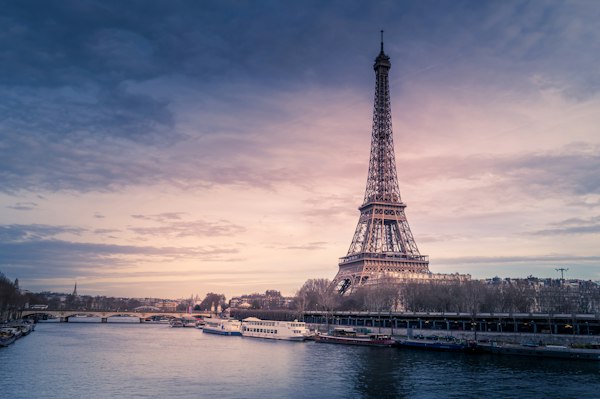
Walk along the quays below Pont d'Iéna for a water-level view that captures the Eiffel Tower with its reflection in the Seine. The lower perspective creates a sense of grandeur. Houseboats and passing Bateaux Mouches add atmospheric foreground interest.

Best for: Reflection shots, long exposures, and including the Seine in your composition.

8. Montparnasse Tower

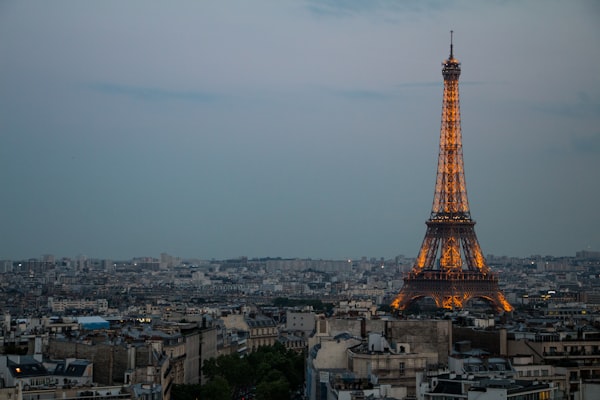
The 56th-floor observation deck of Tour Montparnasse offers the only elevated view in Paris that includes the Eiffel Tower in the skyline. At 210 meters high, it provides a unique aerial perspective. Bonus: you can't see the Montparnasse Tower from up there.

Best for: Aerial cityscape shots, sunset panoramas, and skyline photography.

9. Pont d'Iéna

The bridge directly at the foot of the Eiffel Tower delivers dramatic low-angle shots with the iron lattice towering directly overhead. Walk to the center for symmetrical shots looking up through the base structure. At night, the bridge itself is beautifully lit.

Best for: Dramatic upward angles, symmetrical base compositions, and night photography.

10. Hidden Gem: Avenue de Camoens

This short, steep street near Trocadéro offers an intimate, tree-lined view of the tower through wrought-iron railings. Almost unknown to tourists, it delivers a uniquely Parisian composition with lush greenery framing the iron structure. Best in spring when the trees are in bloom.

Best for: Unique angles, avoiding crowds entirely, and spring photography with cherry blossoms.

Best Time of Day
for Eiffel Tower Photos

The difference between a forgettable snapshot and a breathtaking image is almost always about the light. Here is when to shoot.

Sunrise

6:00 – 7:30 AM

Soft pink and orange light bathes the tower's iron lattice. The biggest advantage: virtually no crowds at Trocadéro. You will have the plaza to yourself. The light comes from the east, backlighting the tower with a warm glow. Check sunrise times for your travel dates as they shift dramatically by season.

Golden Hour

1 Hour Before Sunset

The most universally flattering light. The warm, low-angle sun paints the tower in golden tones and creates long shadows that add depth and dimension. Face the tower from Trocadéro with the sun behind you for even illumination, or shoot from Champ de Mars for dramatic backlighting and silhouettes.

Blue Hour

20–40 Min After Sunset

The magical window when the sky turns deep blue and the tower's lights glow amber against it. This produces the most dramatic, saturated images. Use a tripod for sharp results at slow shutter speeds. The contrast between warm tower lights and cool sky creates visual tension that makes images pop.

Midday

11:00 AM – 3:00 PM

Generally the worst time for Eiffel Tower photography. Harsh overhead light flattens the tower's three-dimensional iron structure, removes shadows, and washes out colors. If you must shoot midday, look for creative angles: shoot upward through the base, use polarizing filters to cut glare, or focus on architectural detail shots.

Camera Tips for
Eiffel Tower Photography

Whether you are shooting with a flagship smartphone or a professional mirrorless camera, these settings and gear recommendations will elevate your images.

Phone vs. Dedicated Camera

Modern smartphones (iPhone 15 Pro, Samsung Galaxy S24 Ultra, Pixel 8 Pro) produce excellent Eiffel Tower photos in daylight. Their computational photography and night modes handle most scenarios well. However, a dedicated camera with interchangeable lenses gives you more control over depth of field, better low-light performance without noise, and the ability to capture long exposures.

Verdict: Phones are perfectly fine for daytime and social media. Bring a dedicated camera if you want large prints, night photography, or creative lens effects.

Recommended Lenses

Wide angle (16–35mm): Essential for capturing the full tower from close range. Use 16mm at the base for dramatic upward perspectives. A 24mm captures the full tower with context from Trocadéro.

Standard (35–70mm): The 50mm focal length produces the most natural-looking perspective, closest to what the human eye sees. Perfect from mid-distance spots.

Telephoto (70–200mm): Compresses the tower against the city background. Ideal from Montparnasse Tower or distant viewpoints to make the tower appear larger relative to surroundings.

Tripod Rules & Alternatives

Tripods are generally permitted in all public spaces around the Eiffel Tower, including Trocadéro, Champ de Mars, and along the Seine. However, they are restricted inside the tower's platforms and in some museum spaces. A lightweight travel tripod (under 1.5kg) is ideal. For handheld stability, brace your arms against your body, lean against a railing, or use a bench as a makeshift rest.

Essential Camera Settings

Daytime: ISO 100–200, f/8–f/11 for maximum sharpness across the frame, auto shutter speed. Shoot in RAW format for flexibility in post-processing.

Golden hour: ISO 200–400, f/5.6–f/8. Slightly wider aperture to gather more warm light while retaining sharpness.

Night (tripod): ISO 100–200, f/8–f/11, shutter speed 2–15 seconds. Use a 2-second timer or remote shutter to avoid camera shake.

Night (handheld): ISO 1600–3200, widest aperture available (f/1.8–f/2.8), shutter speed 1/30s or faster. Enable image stabilization.

Framing the
Eiffel Tower

The Eiffel Tower is one of the most photographed structures on Earth. These composition techniques will help your images stand apart from the millions taken every year.

01

Use Leading Lines

Paris is full of natural leading lines that draw the eye to the tower: bridge railings, tree-lined avenues, Seine riverbanks, and Haussmann building rooflines. Position these lines so they converge toward the tower for a dynamic, three-dimensional composition that pulls the viewer into the image.

02

Frame Within a Frame

Shoot the tower through archways, between building columns, through tree branches, or beneath Pont de Bir-Hakeim. This technique adds depth, creates a sense of discovery, and gives the viewer context about the surrounding Parisian environment.

03

Include Foreground Interest

A lone figure walking, a café table with croissants, Seine river boats, vintage lampposts, or spring cherry blossoms in the foreground transform a simple tower photo into a story. The Eiffel Tower becomes the backdrop to a moment rather than just a landmark.

04

Break the Rules

Not every Eiffel Tower photo needs to show the full structure. Crop to just the top, shoot through the ironwork from underneath, capture its reflection in a puddle, or focus on the intricate lattice details. Some of the most compelling images show fragments rather than the whole.

Night Photography
& the Copyright Question

The Eiffel Tower illuminated against the Paris night sky is one of the most magical sights in the world. Here is how to capture it, and what you need to know about copyright.

Night Photography Techniques

Set your camera on a tripod and use a long exposure of 4–10 seconds at f/8, ISO 100–200 for razor-sharp results with beautiful light trails from passing cars. For the sparkling light show (every hour on the hour, lasting 5 minutes), use a faster shutter speed of 1/15–1/4 second to freeze individual sparkles, or go longer for light streaks. Shoot from Trocadéro or Pont de Bir-Hakeim for the best nighttime compositions.

The Illumination Copyright

The Eiffel Tower's daytime appearance is in the public domain. However, the nighttime illumination design (created in 1985) and the hourly sparkling light show (added in 2000) are considered artistic works protected by French copyright law. For personal social media sharing, this is rarely enforced. For commercial use (prints for sale, advertising, editorial), you technically need permission from the SETE. When in doubt, consult a rights management service.

Best Night Vantage Points

Trocadéro: Classic head-on night view. Arrive early to claim a railing spot.

Pont de Bir-Hakeim: The bridge columns lit at night create dramatic framing.

Seine riverbanks: Capture the tower's reflection dancing on the water.

Montparnasse Tower: Open until 11:30 PM; the best elevated night panorama.

Light Show Schedule

The sparkling light show runs every hour on the hour from sunset until 1:00 AM (or 11:45 PM during off-season). Each display lasts exactly 5 minutes. Position yourself and test your settings at least 10 minutes before the hour. The first sparkle show after sunset, during blue hour, produces the most photogenic results because the sky retains some color rather than being pure black.

The Eiffel Tower
Through the Seasons

Each season transforms the Eiffel Tower's surroundings and light, offering entirely different photographic opportunities throughout the year.

Spring

Cherry Blossoms & Magnolias

Late March through mid-April brings cherry blossoms and magnolia trees into bloom around Champ de Mars and Trocadéro. The pink and white petals framing the iron tower create some of the most sought-after images. Head to Square du Champ de Mars for the best cherry blossom foregrounds. Arrive at sunrise before Instagram crowds descend.

Summer

Late Sunsets & Long Days

Golden hour extends past 9:30 PM in June and July, allowing for warm-light photography after dinner. The long twilight produces extended blue hours lasting 30–40 minutes. Summer also brings lush green gardens on Champ de Mars. Downside: the largest tourist crowds of the year. Shoot early morning or late evening to avoid them.

Autumn

Golden Leaves & Moody Skies

October and November transform the surrounding trees into amber and gold, complementing the tower's own warm iron tones. Overcast skies create soft, even lighting ideal for detailed architectural shots. Fog and mist occasionally shroud the upper sections, creating atmospheric, moody images. Fewer tourists mean more patient, considered photography.

Winter

Christmas Lights & Snow

The Eiffel Tower's Christmas markets and surrounding holiday decorations add festive charm from late November through early January. On rare snowy days, the tower dusted in white is extraordinarily photogenic. Winter sunsets arrive around 4:30–5:00 PM, making golden hour accessible without staying out late. Fewer tourists year-round.

Drone Photography
& Professional Shoots

Drone Rules in Paris

Drones are strictly prohibited in all of central Paris. The city is classified as a permanent no-fly zone by French aviation authorities (DGAC). This includes all areas around the Eiffel Tower, Champ de Mars, Trocadéro, and the Seine. Violations carry fines of up to €75,000 and potential imprisonment of up to one year.

There are no recreational drone permits available for central Paris. Professional film crews may apply for special authorization through the Paris Prefecture, but approval is rare and requires months of advance coordination, insurance, and a licensed operator.

Alternatives to Drone Shots

For aerial perspectives without a drone, visit the Montparnasse Tower observation deck (56th floor), the terrace of Galeries Lafayette Haussmann (free), or the rooftop of the Centre Pompidou. These elevated locations offer legally accessible bird's-eye views of the Eiffel Tower and the Paris skyline.

Hiring a Professional Photographer

For engagement photos, couples sessions, or family portraits with the Eiffel Tower, consider hiring a local photographer who knows the best angles and timing. Expect to pay €200–500 for a 1–2 hour session with edited digital files. Book at least 2–4 weeks in advance, especially during spring and summer peak season. Check portfolios on platforms like Flytographer, Localgrapher, or directly on photographer websites.

Commercial Photography Permits

Personal photography around the Eiffel Tower requires no permit. For commercial photo shoots (fashion, advertising, film), you need authorization from the Paris City Hall (Mairie de Paris) if shooting on public property like streets and parks. Shoots inside the Eiffel Tower or on its platforms require separate permission from SETE. Allow 3–6 weeks for permit processing and budget for location fees.

Eiffel Tower Photography
FAQ

Q1

Where is the best spot to photograph the Eiffel Tower?

The Trocadéro esplanade offers the most iconic, centered view. For something more unique, try Rue de l'Université for a Parisian street scene or Pont de Bir-Hakeim for cinematic framing through steel columns. Each spot offers a different mood and angle.

Q2

Can I photograph the Eiffel Tower at night?

Yes, for personal use. The nighttime illumination and sparkling light show are copyrighted artistic works, so commercial use requires permission from the SETE. Personal photos shared on social media are practically never subject to enforcement, but it is worth knowing the rules.

Q3

What time of day is best for photos?

Golden hour (one hour before sunset) and blue hour (20–40 minutes after sunset) produce the most stunning results. Sunrise gives you empty locations. Avoid midday when harsh light flattens the tower's dimensional iron structure and crowds peak.

Q4

Can I fly a drone near the Eiffel Tower?

No. All of central Paris is a permanent no-fly zone for drones. Fines reach €75,000 with potential imprisonment. No recreational permits are available. Use elevated observation decks like Montparnasse Tower for aerial-style perspectives instead.

Q5

Do I need a tripod?

Not for daytime shots. For blue hour and night photography, a tripod dramatically improves image quality by allowing long exposures at low ISO. Tripods are permitted in all public spaces around the tower but restricted on the tower's platforms themselves.

Q6

What camera settings should I use?

Daytime: ISO 100, f/8–f/11, auto shutter speed. Golden hour: ISO 200–400, f/5.6–f/8. Night with tripod: ISO 100, f/8, 2–15 second exposure. Night handheld: ISO 1600–3200, widest aperture, 1/30s minimum. Always shoot RAW for post-processing flexibility.